Retrofitting condition monitoring does not necessarily require a new machine controller. Existing signals can often be read through an approved interface, or additional sensors can fill a specific information gap. What matters is whether the measurement reveals a relevant change early enough for someone to act. This guide compares three approaches, explains the main cost items and provides a checklist for acceptance.
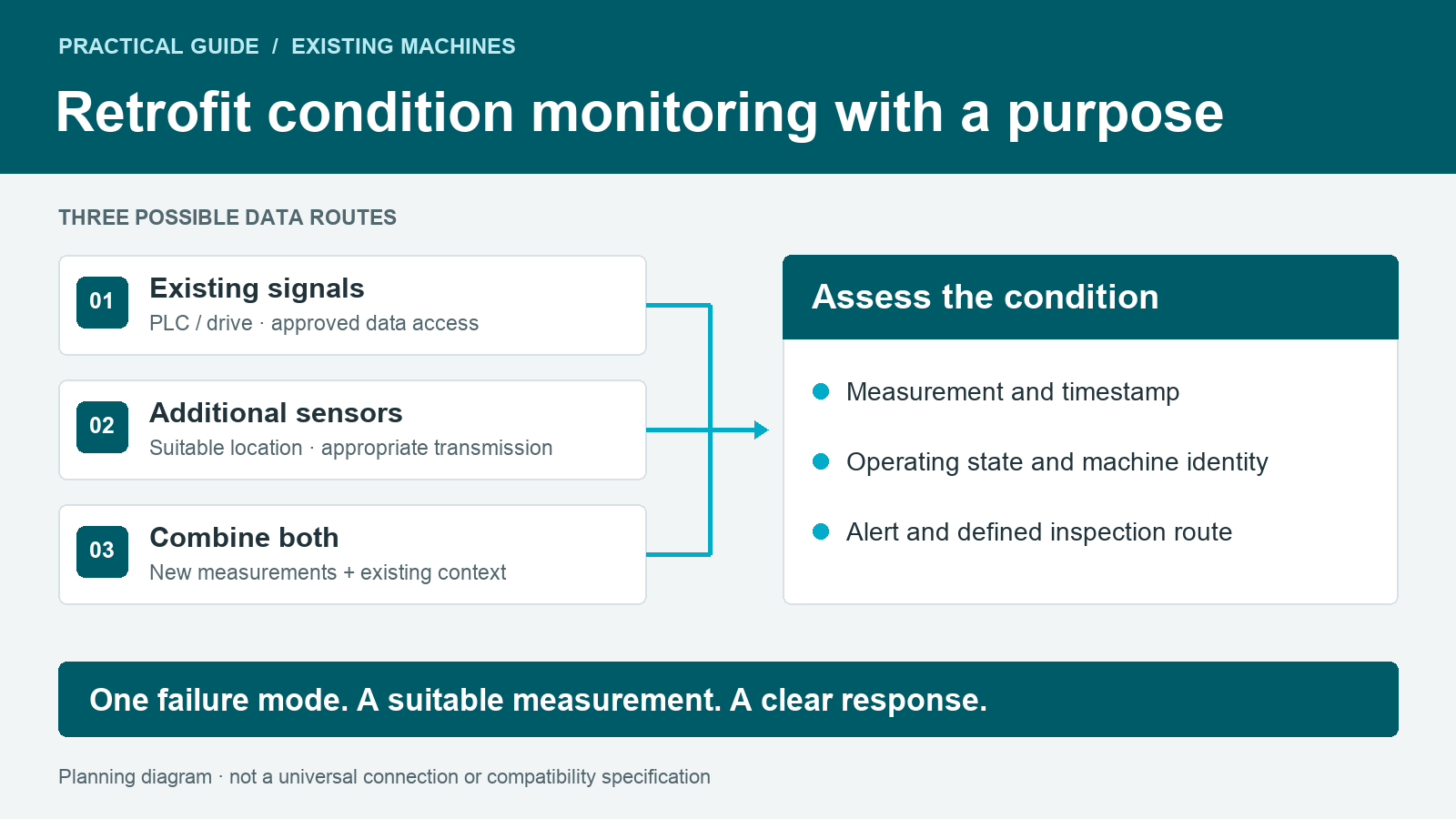
An older machine still produces good parts, but the same pump keeps causing interruptions. The controller offers limited connectivity, documentation is incomplete, and maintenance only hears about the problem when production stops. A focused monitoring retrofit may help. The starting point is the recurring failure, rather than a plan to instrument every machine in the plant.
Define the fault you want to detect earlier. Then choose the measurement, data connection and software.
In this guide:
- Choosing the right machine
- Three ways to collect the data
- Matching measurements to the problem
- Example: a machining cell coolant pump
- Costs and payback
- Acceptance before routine operation
- Frequently asked questions
Which existing machines are suitable?
Age alone is a poor selection criterion. Consider the consequences of failure, the machine's mechanical condition and its remaining useful life. A twenty-year-old production bottleneck may be a good candidate if it will stay in service for several more years. A machine scheduled for replacement needs a much shorter payback period.
Check four things first:
- A specific failure: Which component or process causes recurring interruptions? General visibility is rarely a precise enough project objective.
- A detectable precursor: Does a measurable change occur before the failure? Trend monitoring offers limited protection against sudden failures with no useful warning.
- Time to respond: Is there enough time between detection and failure to inspect the machine, obtain parts or arrange planned maintenance?
- A feasible response: Who can act on the warning? A useful measurement still needs people, parts and access to the machine.
If most downtime comes from missing material or scheduling problems, vibration sensors are unlikely to be the first investment to make. The method must match the cause. Our guide to machine condition monitoring explains the main monitoring methods.
Three retrofit approaches: existing signals, new sensors or both
A network port does not guarantee access to the measurements you need. Conversely, a machine without a modern controller may still be suitable for an independent monitoring system.
| Starting point | Possible approach | Check before choosing |
|---|---|---|
| The controller or drive already provides useful measurements | Read existing data through an approved interface | Access rights, protocol, signal definitions, update rate and additional controller load |
| The relevant condition is not currently measured | Add sensors with suitable acquisition, processing and transmission | Measurement location, mounting, environment, power and maintenance access |
| Available measurements lack the context needed for interpretation | Combine machine signals with additional sensors | Time alignment, asset identity, operating state and data quality |
Check existing signals before buying hardware
Run status, cycle counts, pressure and motor current may already be available. Establish each signal's unit, meaning and timestamp. An averaged value is different from a high-resolution waveform. A drive parameter expressed as a percentage also needs a clear technical interpretation.
OPC UA and other interfaces are possible routes where the particular machine supports them. This does not establish compatibility with every legacy controller. Include licences, manufacturer approval and access to documentation in the initial assessment.
Add sensors to answer a defined question
External sensors can measure vibration at an appropriate bearing housing location or temperature at a suitable measurement point. Wired and wireless approaches have different requirements for installation, communication, power and maintenance. Select them against the actual measurement task.
An independent monitoring system may not need write access to the PLC. That does not automatically permit installation while the machine is running or remove the need for approval. Mounting, electrical work and later maintenance access must fit the equipment's operating and safety arrangements.
Include operating context where loads change
A vibration reading without speed or operating state can be difficult to interpret. Start-up is different from steady production. Fraunhofer EMFT describes how process steps and mechanical load influence condition assessment. For a retrofit, the practical implication is to include context in the measurement plan.
Which measurements help with which problems?
Choose sensors against the failure mode. The following table is a starting point for engineering discussion, rather than a universal equipment specification.
| Problem to investigate | Possible measurements | Important limitation |
|---|---|---|
| Changes in rotating components | Vibration indicators or frequency data, with speed and temperature where relevant | A high reading alone does not prove bearing damage; mounting and operating state affect the signal |
| Unstable process supply | Pressure, flow and operating state | A pressure drop has several possible causes; sensor location must match the question |
| Increasing thermal load | Temperature trend, ambient temperature and load | Temperature can respond slowly and does not replace every other diagnostic method |
| Changes in drive behaviour | Current, power, runtime or cycle time | Higher current may reflect a changed load rather than wear |
Keep three rates separate: signal acquisition, indicator calculation and data transmission. A slowly changing temperature trend and a bearing vibration analysis need different measurement arrangements. A dashboard updated once per second does not establish that the underlying measurement is adequate for the intended diagnosis. Balluff's description of integrated data processing provides a technical example of processing high-frequency measurements directly in a sensor.
Specify how missing data will appear. The last received value must not be presented as a fresh reading indefinitely. Timestamps, signal quality and visible communication loss belong in the acceptance criteria.
Anonymised practical example: retrofitting a machining cell coolant pump
A machining cell repeatedly reports insufficient coolant pressure. Maintenance currently investigates only after the interruption. The initial objective is to detect a gradual pressure reduction earlier under comparable operating conditions.
The starting point: A pressure signal is available through an approved data route. Pump enable status and the machining programme are also accessible. Replacing the controller is not initially required for this measurement task.
The team evaluates pressure during phases in which the pump is enabled and comparable supply conditions are expected. Start-up and intentionally inactive phases are treated separately. Otherwise, normal programme changes would repeatedly appear as faults.
A suitable warning range and allowable deviation duration are established from approved process requirements and a checked reference period. There is no universal pressure threshold in this example: selecting one without the pump, tooling and process specifications would be misleading.
The response: Maintenance receives the machine identifier, time, pressure history and operating state. An approved inspection process helps determine whether the filter, supply, sensor or pump needs further investigation. The measurement provides evidence, rather than a definitive root cause. An expert can join through ADTANCE Support where useful.
The close-out: After the intervention, pressure is checked again under comparable conditions. Acknowledging the alert is not evidence that the action worked. If the existing pressure signal proves unsuitable, improve the measurement first. Add another sensor when it answers a specific unresolved diagnostic question.
How much does a condition monitoring retrofit cost?
A sensor price is only one part of the project. Two similar machines can require very different budgets if one provides documented signals and the other needs new measurement locations, connectivity and approvals.
Ask for the following items to be separated in a proposal:
| Cost item | What to include |
|---|---|
| Assessment and planning | Failure mode, available signals, measurement design, responsibilities and approvals |
| Hardware and installation | Sensors, mounting, cabling, gateway where required, power and installation work |
| Data integration | Interfaces, licences, signal mapping and time alignment |
| Software and operation | Visualisation, storage, accounts, recurring fees and support |
| Commissioning | Reference measurements, alert rules, training and documented acceptance |
| Ongoing maintenance | Alert handling, changes after process modifications, updates and battery replacement where applicable |
A payback example with explicit assumptions
These figures are invented calculation inputs, not market prices or an ADTANCE quotation:
- initial project cost: EUR 6,000;
- additional annual operating cost, including internal support: EUR 1,200;
- economic benefit per genuinely avoided downtime hour: EUR 500;
- downtime expected to be avoidable through this particular measure: ten hours per year.
Annual benefit is 10 × 500 = EUR 5,000. Subtract operating cost to obtain EUR 3,800 per year. Simple payback is 6,000 ÷ 3,800 = approximately 1.6 years. This simplified calculation excludes financing, tax and variations in the timing of cash flows.
The critical assumption is the ten hours. Do not use all historical downtime: include only losses the proposed measurement and response can plausibly influence. If production can be fully recovered later, check whether lost contribution margin is appropriate. Avoid counting labour, scrap and restart costs twice.
Now test a weaker outcome. With only two avoided hours, annual benefit falls to EUR 1,000 against EUR 1,200 of operating cost. There is no payback under those assumptions. This sensitivity check is more useful than claiming that every retrofit will recover its cost within months.
What should be demonstrated before routine operation?
A dashboard showing changing values is an intermediate result. Data quality, interpretation and operational response must work together.
- Measurement: Check units, scaling, timestamps, asset mapping and whether mounting is suitable for the measurement.
- Normal operation: Include relevant loads, programmes and operating states in the reference. One quiet shift may not represent everyday production.
- Notification: Use an approved test case to confirm that the right person receives sufficient context. Do not deliberately create a real machine fault.
- Data loss: Verify that failed sensors and interrupted connections are distinguishable from healthy machine conditions.
- Action: Establish an approved inspection route, cover for absent staff and a close-out rule.
- Operation: Assign responsibility for access rights, updates and changes after machine modifications.
IT and OT should approve the data route together. Review read-only access, network segmentation and limited permissions. Read-only access alone does not make a connection secure. Any additional remote maintenance connection needs its own security assessment. DGUV guidance FBHM-133 addresses safe remote maintenance of machinery.
An ordinary condition monitoring system is not a substitute for a safety-rated protective function. Monitoring, interventions and machine safety functions need distinct roles in the equipment design.
Frequently asked questions
Can a machine without a PLC interface be monitored?
Often, provided the relevant measurement can be acquired using additional sensors and an independent data route. Mounting, power and operating context still need to be considered. For some applications, missing controller information makes normal load changes difficult to distinguish from a fault.
Do we need to connect the entire machine fleet immediately?
No. Start with one machine and one clearly defined failure mode. After a suitable reference and trial period, assess the measurement, alert and response together. Then decide which parts of the design can transfer to other machines.
Is AI or predictive maintenance necessary?
Not always. Technically justified thresholds and trends can be sufficient for some tasks. Predicting remaining useful life is a further requirement that needs appropriate data and validation. Installing a new sensor does not automatically provide a reliable failure prediction.
How long does a retrofit take?
It depends on data access, installation, approvals and operating conditions. Separate installation time from the period required to establish a representative reference and complete acceptance. A measurement appearing quickly on screen does not mean its interpretation has been validated.
Can existing and new sensors be combined?
Yes, where access, interfaces, timing and asset mapping are compatible. Combining them can be useful when speed, load or process information is needed to interpret an added measurement. Compatibility must be checked for the particular machine.
Turn a retrofit into usable condition information
A retrofit earns its place when it closes a specific information gap between the machine and maintenance. That requires a suitable measurement, useful context and a response that works during routine operations.
ADTANCE PVM brings machine and sensor data together, visualises conditions and thresholds, and supports defined alerts. Depending on the application, existing data sources can be supplemented with additional sensors or a gateway. The connection is assessed for the particular machine.
Planning to monitor an existing machine? Describe the machine type, recurring fault and available signals. These provide a practical starting point for discussing the measurement task and what needs to be resolved before installation.
Discuss your retrofit with ADTANCE
Editorial team: ADTANCE. The financial calculation uses illustrative assumptions, not measured project results.